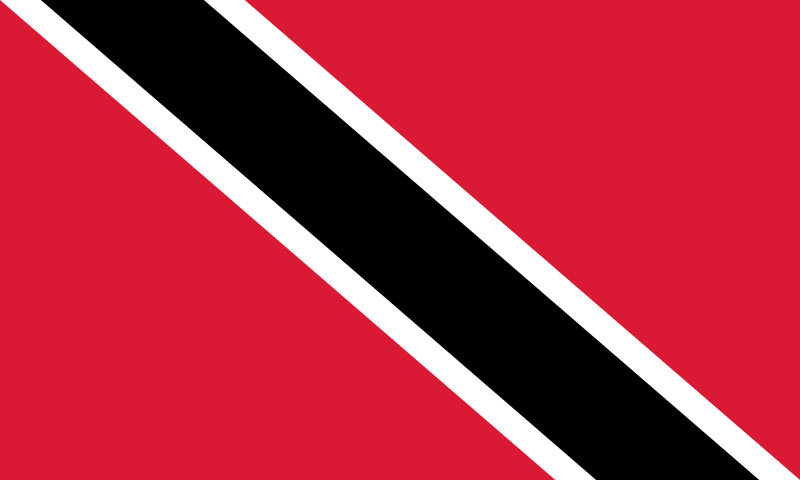
Trinidad and Tobago
Port of Spain · Unitary parliamentary republic
UN MEMBER STATEOverview
Trinidad and Tobago is a North America nation with a unitary parliamentary republic system, and its delegation approaches the United Nations as a full member state. With a population of 1.4 million and an economy of roughly $27 billion, it carries interests shaped by its geography, history, and regional alignments. For MUN delegates, Trinidad and Tobago typically behaves as a pragmatic actor that frames issues through the lens of its national development and sovereignty. Understanding its blocs and negotiating style is essential to building coalitions in committee.
Quick Facts
Government & Political System
Trinidad and Tobago operates a unitary parliamentary republic, with power distributed across its institutions and regular channels for national and north america engagement.
Economy & Trade
The economy of Trinidad and Tobago is centred on industry and manufacturing, contributing to its standing of about $27 billion. Economic policy is closely tied to regional integration. Delegates should note how economic priorities translate into the country's positions on development and trade agendas.
Trinidad and Tobago trades primarily within the Global South, with Trinidad and Tobago Dollar as its currency. Trade policy is used as a means of diversification. In economic committees it generally favours rules-based commerce.
Military & Defence
Trinidad and Tobago maintains defence forces oriented to internal and border security. Defence spending reflects its unitary parliamentary republic priorities and its perception of external threats. In security debates it tends to seek balanced deterrence.
Defence posture centres on regional stability. Trinidad and Tobago participates in multilateral training. It frames security debates around sovereignty.
Geography
Trinidad and Tobago lies in North America, with Port of Spain as its capital. Its terrain and climate shape trade routes and influence its foreign-policy choices. Geography also determines many of the environmental and development issues it raises in committee.
Foreign Policy
The foreign policy of Trinidad and Tobago rests on advancing economic diplomacy. It engages multilaterally through the United Nations and regional bodies, often aligning with the GRULAC grouping. Relations with neighbours and major powers are managed through issue-based coalitions.
- Advancing Trinidad and Tobago's economic and development agenda
- Strengthening North America regional cooperation
- Protecting sovereignty and territorial integrity
- Contributing to peacekeeping
- Deepening ties within the GRULAC bloc
- Reforming multilateral institutions for fairer representation
Human Rights
Trinidad and Tobago's human-rights record is discussed in UN forums through the lens of its unitary parliamentary republic traditions and developmental context. It highlights progress on social and economic rights while engaging with international monitoring mechanisms. Delegates should present a balanced, constructive stance on rights issues.
Climate Policy
Trinidad and Tobago approaches climate policy through the principle of common but differentiated responsibilities. It links climate to development and frames the issue as both a challenge and an opportunity.
Treaties & Organisations
Diplomatic Relations & Alliances
Trinidad and Tobago maintains diplomatic relations across the Global South and development partners. Its mission at the UN advances development priorities through both public statements and behind-the-scenes negotiation.
Timeline
- 1945Founding of the United Nations
- 1962Trinidad and Tobago intensifies multilateral engagement
- 2011Key domestic reform shaping foreign policy
- 2019Renewed focus on digital policy
- 2026Participates in JBCN MUN 2026
National Interests & Position
- Protecting the sovereignty and development of Trinidad and Tobago
- Securing North America stability and prosperity
- Expanding trade
- Strengthening the GRULAC bloc
- Promoting multilateralism
- Safeguarding its citizens and diaspora abroad
Trinidad and Tobago generally advocates for multilateral cooperation while defending its concrete national interests. It aligns closely with the GRULAC grouping and bridges Global South and Western positions. Delegates should expect it to favour gradual steps.
MUN Strategy
- General Assembly on development
- UNEP on humanitarian affairs
- UNSC (when seated) on disarmament
- regional bodies on trade
- North America perspectives on sovereignty vs intervention
- Climate justice and finance
- Reform of global financial institutions
- Development before stringent environmental mandates
- Trinidad and Tobago's role in the GRULAC bloc
- Peacebuilding and prevention
Trinidad and Tobago anchors the GRULAC bloc and coordinates with its members on procedure and substance. It works closely with Western partners. Its voting reflects a consistent prioritisation of development.
In the General Assembly Trinidad and Tobago balances bloc loyalty with issue-specific pragmatism. It prefers abstention on divisive votes. Its positions are predictable once its GRULAC alignment is understood.
- Open by stating Trinidad and Tobago and the exact agenda item
- Anchor arguments in development
- Quote a real treaty or UN document Trinidad and Tobago supports
- Signal your GRULAC alignment and likely allies
- End with a constructive, coalition-building call
Trinidad and Tobago negotiates as a pragmatic broker, using its bloc weight to build majorities. It prefers package deals over surprise motions.
- Reaffirm Trinidad and Tobago's core position on the agenda
- Cite a treaty or UN document it upholds
- Propose a concrete, implementable step
- Highlight a North America perspective often overlooked
- Invite the GRULAC bloc and swing states to caucus
- Link the issue to the Sustainable Development Goals
Sample Opening Speech
Mr./Madam Chair, fellow delegates, The delegation of Trinidad and Tobago is pleased to address this committee on an issue central to our region. As a North America nation, Trinidad and Tobago believes that durable solutions must respect sovereignty. We bring to this debate a commitment to development-first thinking. We stand with the GRULAC bloc in seeking outcomes that are inclusive. Trinidad and Tobago looks forward to constructive engagement with all delegations and to forging a consensus that serves not only our region but the wider membership. Thank you.
Research Sources
- CIA World Factbook
- UN official records and voting data
- World Bank data
- Trinidad and Tobago Ministry of Foreign Affairs
- Britannica country profile
- UN Treaty Collection



